How I use LLMs to learn complex topics
摘要
作者分享了自己用大模型学习复杂主题的方法:不直接让 AI 解释,而是先让模型(在 plan mode 下用 CC 或 OpenCode)构建某主题的基础知识库,再让其复核准确性,然后把它做成低多边形、类似《过山车大亨》风格的动画模拟,加上响应式页面和暂停控制等 UX 元素,最后推送到新仓库并用 GitHub Pages 部署。作者用此法做了芯片制造学习站 ChipTycoon,可跟随沙到成品芯片的整个流程。文中还提到改进方向:可用作者自己的图片转 3D 物体技能提升画面真实度,也可在模拟中加入挑战题和谜题帮助记忆。作者还列出了用同样方法做的其他主题页面,如火箭发动机、LLM、F1 发动机、EUV 光刻机。
荐读理由
照这套流程,让模型先建知识库、再审校、再做成交互动画,就能把芯片制造这类复杂主题变成可动手验证的模拟,比干啃文档记得牢
原文
How I use LLMs to learn complex topics
LLMs are used for any things. Learning new things is one of the top use cases.
Many engineers I know use generative AI for many functions, like building PoCs, internal tools or dashboards, or even learning new stuff. I personally find the style used by LLMs to explain things difficult to follow. It's just too simplistic and depending on the number of emojis used, a bit annoying too.
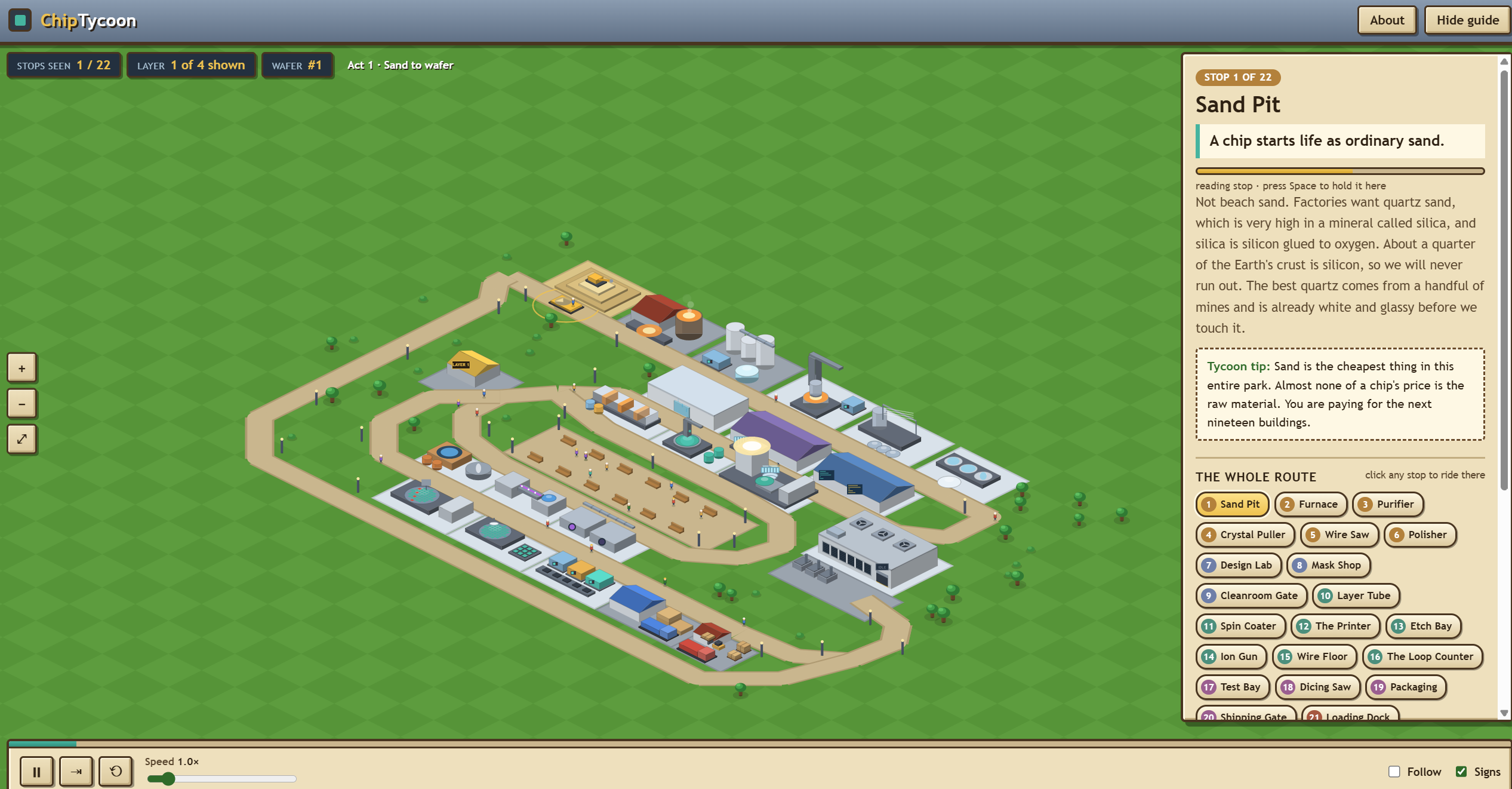
While I was analyzing new AI bottlenecks that might slow down data center buildup, I realized there are many aspects of chip production that I do not know. Surfing the web, I asked myself what if there would be a game to get you through the process of building a chip at a fab? For sure learning this way will stick, since you can map concepts with objects within the game. This is when I decided to try it, and it actually turned out really well.
The flow
Instead of just asking AI to explain a topic, I use the following flow:
In plan mode (using CC, or OpenCode) I ask a model to build the foundational knowledge for X topic.
I ask it to review the accuracy of the knowledge base it built in the previous step.
I proceed asking it to build a simulation of that topic in a low-poly, Rollercoaster Tycoon-like animation. I add some UX elements as well, like the page needs to be visible on both large and small screens, have controls to stop the flow whenever I want etc.
I then push it to a new repo and enable GitHub Pages for it.
The result
What you get is a beautiful animation that is 100% accurate and free of hallucinations. For me, this method works a lot better than just reading endless materials that I find on Google, or trying to digest a bulleted list that is spat by a language model.
I've done this specifically for learning chip building and launch it under this website: ChipTycoon. You get to follow a cart from the moment when sand is collected, to the moment when a chip is finalized and delivered to a data center.
Visually, you can follow the cart and see how it changes too. Since it's low-poly, the details might be missing, but it's still a good indicator for showing how the product changes once it goes through the many steps required in the manufacturing process.
How to improve it further
Let's say that the low-poly design requires to much immagination to actually visualize what happened to the quartz sand pile after it left the furnace. To transform this into a more realistic representation, you can use my skill for transforming pictures into 3d objects, and map the resulting objects to your simulation. This way you get more accurate design.
Also, you can add challenges to your simulation too. Trying to answer questions about a previous step in the chip manufacturing process will help you retain the knowledge tremendously. Add intuitive puzzles too that will help you learn even better.
Check out what other pages I created:
这条对你有帮助吗?