Zero-Touch OAuth for MCP
摘要
文章介绍了 MCP 的 Enterprise-Managed Authorization(EMA)扩展已进入稳定状态,目标是解决企业环境中反复 OAuth 授权带来的使用和管理成本。原有按用户逐个授权的模式会导致入职配置繁琐、缺乏统一审计与策略控制、以及个人与企业账号混用等问题。EMA 将授权上收到企业身份提供商(IdP)统一管理,用户通过单点登录即可获取由组织策略决定的 MCP 服务器访问权限。 其核心流程是用户登录时通过 IdP 获取身份断言 JWT(ID - JAG),再换取 MCP server 的访问 token,整个过程不需要逐个服务的授权弹窗,从而实现 “授权一次,处处继承” 的体验,并强化集中审计与安全控制。 落地方面,文中提到 Model Context Protocol 生态已有多方参与:身份提供商 Okta 首先支持该机制;客户端侧 Anthropic 已在 Claude、Claude Code 等中集成,Visual Studio Code 也已支持;服务端包括 Asana、Atlassian、Canva、Figma、Linear、Supabase 等已支持或正在接入,Slack 也在推进中。文章最后鼓励更多 IdP、客户端与服务器加入该标准生态。
荐读理由
企业可把 IdP 当授权决策核心,管理员一次设组/角色规则,用户登录时自动接管所有支持服务器,不用每次 OAuth
原文
Enterprise-Managed Authorization: Zero-touch OAuth for MCP
The Enterprise-Managed Authorization extension to the Model Context Protocol is now stable, enabling organizations to centrally provision MCP server access through their identity provider so users get connected servers on first login without per-app OAuth.
Table of Contents
Per-user auth is high friction
Authorize once, inherit everywhere
Early adopters
Get involved
Acknowledgements
The Enterprise-Managed Authorization extension is now stable. Organizations can centrally manage authorization for MCP servers and end-users can access all connected MCP servers through a single log in. The extension is being adopted by Anthropic, Microsoft, Okta and a growing number of MCP servers.
The Enterprise-Managed Authorization (EMA) extension is now stable. We’ve heard from the community that authorization and repeated consent prompts from connected MCP servers is one of the biggest pain points when it comes to managing connectivity in enterprise environments. This extension helps address this.
EMA allows organizations to control MCP server access centrally through their trusted identity provider. For end-users, this means a zero-touch setup: the MCP servers they need are connected on first login, with no per-app OAuth and nothing to configure as a one-off.
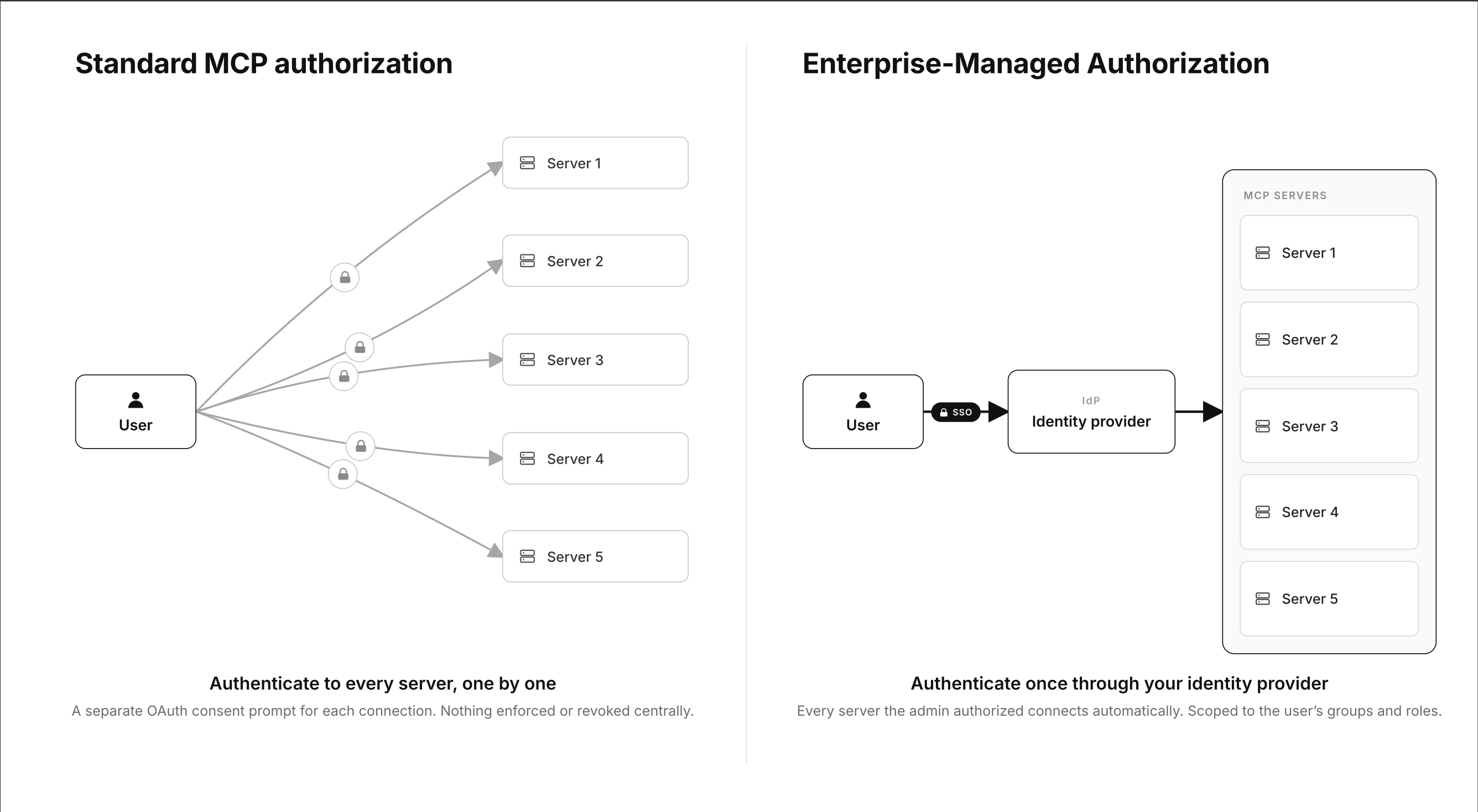
Per-user auth is high friction#
The standard MCP authorization model was designed to be user-scoped and bound to the traditional interactive auth conventions. While this might work well for more general consumer scenarios where individuals decide what touches their data, this doesn’t quite scale for enterprise deployments:
Every employee has to authorize every server individually: onboarding means manually connecting service after service.
Security teams cannot enforce consistent policy: access is whatever each user authorized, with no central control or audit trail.
Work and personal accounts blur together: there’s no way to require a corporate identity, so a user can connect a personal account to a work tool.
This combination of factors slows MCP adoption and pushes people toward brittle workarounds. With no universal standard for preserving shared auth state, everyone invents their own bespoke solution. The data and tools are available, but the per-user authorization tax keeps most of them switched off.
Authorize once, inherit everywhere#
Enterprise-Managed Authorization makes the organization’s IdP the authoritative decision-maker for MCP server access. Administrators define the policy once and users can authenticate with their existing identity into the MCP host. The IdP can grant or deny access based on group membership, role, and conditional access rules.
Under the hood, the client obtains an Identity Assertion JWT Authorization Grant (ID-JAG) from the IdP during single sign-on and exchanges it for an access token from the MCP server’s authorization server. The user is never redirected through a per-server consent screen. Three properties fall out of that flow:
Authorize once, inherit everywhere: admins enable a server for the org. Users get it automatically, scoped to the groups and roles they already have.
Centralized policy and audit: access decisions live in the IdP admin console, with one auditable trail across every connector.
Removing personal/enterprise mixups: by removing the interactive account selection step, it’s much easier to prevent data flowing between personal and enterprise accounts by mistake or compromise.
We see this as a brand new baseline for MCP in the enterprise. When users log in, their client should be connected to the tools and data they’re authorized to use with no extra steps in between.
Early adopters#
This launch brought together three groups that collaborated closely on making the implementation real:
Identity providers: Okta is the first supported identity provider. Organizations using Okta can provision MCP access to supported servers through any supported client, using Okta’s Cross App Access (XAA).
Clients: Anthropic has implemented the extension in its shared MCP layer for Claude. Admins can authorize MCP servers for users across Claude, Claude Code, and Cowork. Additionally, Visual Studio Code has also added support for EMA right in the IDE.
Servers: Asana, Atlassian, Canva, Figma, Granola, Linear and Supabase now support EMA, with Slack and more actively adding support.
We’re excited for more identity providers, clients, and servers to adopt Enterprise-Managed Auth to help reduce the authorization-related fatigue and significantly improve the security and observability posture for its implementers.
“The momentum around MCP is incredible, but as we move toward an interconnected AI workforce, security can’t be an afterthought. By embedding the Cross App Access protocol into MCP as the Enterprise-Managed Authorization extension, we turn identity into a centralized governance plane and give security teams strict compliance control and users a seamless, secure experience.”
— Aaron Parecki, Director of Identity Standards, Okta
“The Figma MCP brings the power of code and canvas together so teams can move faster, explore more and ship products that stand out. As MCP adoption grows, XAA makes it easier for enterprises to scale their MCP deployments securely without slowing teams down.”
— Devdatta Akhawe, VP of Engineering, Figma
“Logging in once and automatically having all your MCP connectors automatically setup is pretty magical.”
— Tom Moor, Head of Engineering, Linear
Get involved#
As with all other MCP extensions, features, and enhancements, we welcome your input. We’re encouraging clients, servers, and identity platforms to review the extension specification and add support for the new standard into their products:
Read the requirements: the Enterprise-Managed Authorization page documents the flow for clients, servers, and authorization servers.
Source and draft spec: see the ext-auth repository and the draft specification for the latest in EMA evolution as well as any support materials that will help you get started.
If you’re interested in discussing the extension, sharing compatibility reports, or iterating on the extension, join the EMA Interest Group.
Acknowledgements#
Enterprise-Managed Authorization is the work of the MCP community: the authors of SEP-990, the maintainers of the ext-auth repository, and the identity and MCP providers who tested early implementations and pushed the spec forward. Thank you to everyone who contributed.
这条对你有帮助吗?