The Cold Email
摘要
作者 Zach Holman 以亲身经历讲述冷邮件(cold outreach)如何改变人生:通过额外寄送材料从卡内基梅隆候补名单转正、2010 年给 GitHub 创始人发冷邮件获得工作、通过 Twitter 私信最终成为足球俱乐部股东。他也承认存在幸存者偏差,但认为人们容易记住成功案例而忽略失败,因此鼓励在真诚、尊重对方的前提下主动出击,同时作为接收方也应保持开放心态,接受冷邮件和冷投递。
荐读理由
文章提供了冷邮件实操的具体案例和心态建议(如真诚、尊重、不功利),可迁移到独立开发者寻求合作、融资或人脉的场景;同时指出幸存者偏差但强调主动出击的价值,能改变对冷邮件成功率的悲观判断。但证据均为个人轶事,缺乏系统性数据,属于间接证据。
原文
Three of the biggest changes in my life all stemmed, in part, from cold outreach.
Originally I was waitlisted at Carnegie Mellon. Getting waitlisted is like, being the first loser: you’re good enough to be in the topic of conversation, but they make it clear that you’re not good enough to actually get accepted. My dad had me next day air an additional essay about what I was working on at the time (I had built Good-Tutorials, which was the largest tutorial website on the planet, so that was something different). I also included a bunch of other material and things about me and my senior year.
I thought doing all of this was pretty silly and a waste of time — didn’t I mention this all before? — but my dad kept saying it wouldn’t hurt to really make it clear I wanted to get into the school. I got in shortly thereafter. Didn’t realize it at the time, but CMU clears something like 1%-10% off the waitlist, so it was indeed more rare than I had realized. Guess it did make sense to reach out about it after all.
In 2010, Chris Wanstrath tweeted about looking for junior developers who knew Ruby (I did) and Java (uh, sure, I could maybe fake it). GitHub at the time was kind of the most clique-y of startups; they had made it clear that practically all hires at that point they had worked with previously or interacted through open source. No one knew who I was, and it was frankly pretty intimidating to fire off this email:
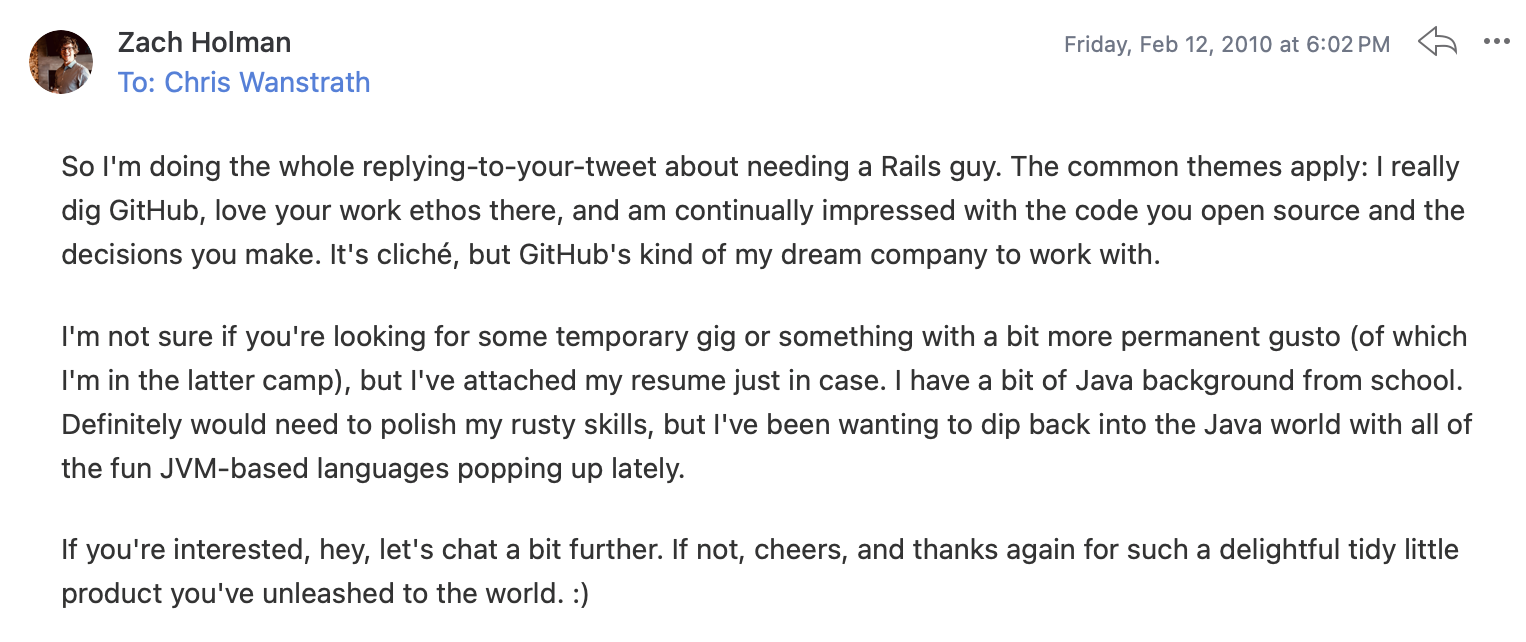
Couple weeks later we met at Hotel Utah and they hired me on the spot. Still don’t know why they did; there were plenty of better programmers of both languages out there to choose from (this is back when you had to type code with your fingers). In hindsight, the company was fairly broke — or at least revenue neutral each month — and a $60k junior developer salary was probably low-risk enough to try. Still, I had reached out and lucked out.
Six years ago I sent a cold DM through Twitter and ended up owning part of a soccer club, which I’ve written about to an excessive degree. That one DM led me on an eventual path to ownership in another soccer club, this time in Serie A, and led to a ton of investments I’ve made in sports/tech and the professional and volunteer work I’ve done across the sport. It has very much become my life’s focus, and it’s not something I would have at all believed you had you told me about it a decade ago. It’s never too late to switch gears.
When cold emails didn’t work for me
This is when the Hacker News commenter or Twitter complainer or whoever will say “well who gives a fuck, it’s just survivor bias”. It’s true; I’ve had a stupid run of great luck in my career, and cherry-picking past results don’t inform future performance. But the difference is I’m also going to tell you all of the cold emails I’ve written that when nowhere and didn’t end up changing my life.
…yeah no; no fucking idea.
I’ve done tons of cold outreach to people I admired, half-contacts I had met once, people who might share interests with me, I’m sure of it. I actually just sent a cold DM this afternoon to someone on Instagram who has a super interesting overlap with me, thought we could have a chat sometime.
But I don’t remember those, not really. It’s kind of the opposite of gambling, where the gambler won’t remember the huge pots won, but they can tell you every second of the bad beat they had in their careers. In this case, you tend not to remember the awkward chat you had with the famous CEO at the meetup, or that one email you fired off three years ago, but you remember the outcome of the things that did go well.
Just do the thing
You can’t win unless you skate to where the puck is going to be buying a lotto ticket.
That is to say: you gotta actually do the thing and reach out and say hi sometimes. It’s occasionally awkward and weird and strange, but it’s usually worth a shot. Standard disclaimer applies, as it does to everything in life, though: actually give a fuck, be interested in the other person, and be genuine. Trust me, I get a ton of cold outreach and virtually all of it I can see through as to whether or not someone’s trying to play me, or is honestly trying to make a real connection.
And the most important part to keep in mind: if you’re reading this and thinking, wow, this is awesome, he’s totally right, I should send that email to Zach right now! That’s definitely not what I’m saying here- leave me alone and go bother someone else.
All jokes aside, the other part of this equation is the recipient. Even though warm job referrals are a fantastic way to hire, I’ve long since decided that no matter what the circumstances were at a company I might run, I’d always accept cold resumes and emails. Kind of a way of paying it forward for the people that did the same for me. Same with cold pitches to my profile on Signed: I’ve invested in many startups that I hadn’t the faintest connection to personally. It greatly expands your own network and helps dismantle blind spots. And it’s just the right thing to do.
It’s also helpful to realize that while you may be sending the cold email today, in another area tomorrow you might be someone else’s cold email. Not every part of life is a linear progression.
So: on occasion, with respect and restraint and genuine good-natured attempts: go out and reach out when it makes sense. Could be good, could be great. And help people, when you can.
◆ ◆ ◆
这条对你有帮助吗?