Einstein's relativity rules chemical bonds in heavy elements, new research shows
摘要
Brown 大学化学家用光电子谱技术冷却铋 - 碳分子并敲出电子,谱图显示碳 - 铋键不符合传统三键(1σ+2π)的严格分离模式,而是呈现 1 个 π 键与 2 个 σ-π 混合键的结构。作者指出,这源于重原子核下电子速度接近光速导致的电子自旋 - 轨道耦合,使 σ 与 π 键的边界模糊,但仍保留三个键。文中提到此验证可能促使化学教科书修订,并列出铋在太阳能电池、量子材料等方面的应用前景。
荐读理由
重元素(如铋)化学键受爱因斯坦相对论影响,实验证实传统三键结构边界模糊,出现sigma-pi混合键;这为量子材料、量子计算等AI/工程领域提供真实的新概念框架
原文
Date July 9, 2026 2026-07-09
Media Contact
Kevin Stacey [email protected] 401-447-3800
Share
Einstein’s relativity rules chemical bonds in heavy elements, new research shows
Researchers have shown the first direct experimental evidence that the textbook triple bond structure breaks down in heavy elements, where relativity makes the rules.
PROVIDENCE, R.I. [Brown University] — Brown University chemists have provided direct evidence that upends the textbook explanation of how triple chemical bonds work in heavy elements.
In a study published in Science, the researchers show evidence that when atomic nuclei are sufficiently heavy, the principles described in Einstein’s theory of relativity change the structure of triple bonds — blurring the lines between the two separate types of bonds involved in textbook triple bonding. Using a technique called photoelectron spectroscopy, the Brown team showed bonds created by carbon and the heavy element bismuth have the telltale signature of relativistic bonds.
“This idea that relativity is important in heavy elements has been around since the 1970s,” said Lai-Sheng Wang, a professor of chemistry at Brown and the study’s corresponding author. “But we show direct spectroscopic evidence that what we learned in high school about chemical bonding isn’t true in heavy elements.”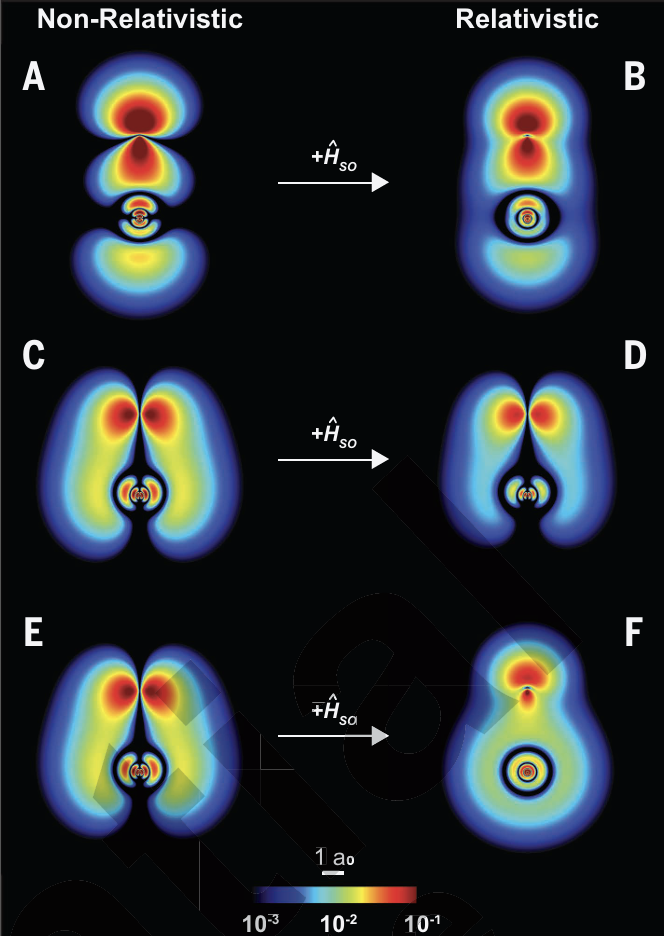
Atoms form bonds by sharing electrons — the negatively charged particles that orbit atomic nuclei. Each atom shares one electron to form a bonding pair. The strong negative charge of the electron pair attracts the two positively charged nuclei, holding them together. Some elements share more than one electron pair, forming double or triple bonds.
The textbook picture of triple bonding involves two different types of bonds: one sigma bond and two pi bonds. The sigma bond is a strong, “head-on” bond that occurs along an imaginary horizontal axis between nuclei. The two pi bonds are somewhat weaker, “side-by-side” bonds that wrap around the sigma bond.
That picture works for lighter elements, but toward the bottom of the periodic table, where atomic nuclei get heavier, things get messy. The increased nuclear mass causes orbiting electrons to speed up to a significant fraction of the speed of light, where the rules of Einstein’s theory of relativity are important.
In the relativistic regime, an electron’s spin — the magnetic moment that points either up or down — and the electron’s orbit are no longer independent of each other, a state known as spin-orbit coupling. That coupling changes the rules for how electrons can interact, disrupting the strict separation between sigma and pi bonds.
“The boundary between a sigma bond and a pi bond is now sort of smeared,” Wang said. “We still have three bonds, but we don't really strictly have a sigma or a pi anymore.”
To show evidence for this bonding hybridization, Wang and his team, led by Brown Ph.D. students Deniz Kahraman and Jie Hui, formed molecules made from bismuth and carbon. Bismuth is a heavy element — right next to lead on the periodic table — where relativistic effects should be important. After cooling the molecules to near absolute zero, the team analyzed them using photoelectron spectroscopy. The technique uses a laser to knock individual electrons out of their positions in the molecule. The distance each electron flies tells the researchers how strongly they were bound.
The photoelectron spectrum showed that the carbon-bismuth bonds did not fit the traditional triple-bond picture of one sigma and two pi bonds. Instead, the structure looks more like one pi bond and two hybrid sigma-pi bonds.
Wang says the experimental verification of the relativistic structure may spur a rewriting of chemistry textbooks, especially as heavy elements — bismuth in particular — garner more research interest. Bismuth could be an alternative to toxic lead in next-generation solar cells. It has also drawn interest in research related to quantum materials and quantum computing.
“Maybe this will become the new textbook idea as we are dealing with more and more heavy chemistry of the heavy elements,” Wang said.
The work was funded by the U.S. National Science Foundation (CHE-2403841) and the U.S. Department of Energy (DE-SC0008501).
Tags
Related news:
Science and Technology
Telescope makers at Brown revel in centuries-old craft
July 8, 2026
Working for months with staff members in the Department of Physics, a group of students and faculty from Brown and RISD learned the art and science of high-precision optics to make their own powerful telescopes by hand.
Science and Technology
Video: Amid World Cup fever, mechanics expert at Brown explains the science of soccer
July 8, 2026
In a series of short videos, Brown University engineering professor Roberto Zenit explores the physics of soccer as the World Cup tournament rolls toward its conclusion.
Science and Technology
Physics-informed AI could accelerate development of controlled-release drug patches, bandages
July 6, 2026
By baking fundamental physical laws into neural networks, researchers have created a model that predicts drug-release timelines using a fraction of the usual lab data.
这条对你有帮助吗?