Satellite reveals immense scale of GPS signal tampering
摘要
文章介绍了 Xona Space Systems 的实验卫星 Pulsar-0 在约 500 公里轨道上,对欧洲和中东区域的 GPS(GNSS)信号进行观测,首次从太空绘制出大范围信号干扰分布图。结果显示,这些区域存在显著的 GPS 信号衰减与干扰(包括 jamming 与 spoofing),强度比预期更高。 数据表明,在受影响区域,GPS 信号强度在卫星高度可从约 40 dB 下降到约 10 dB,导致低轨卫星在从法国到巴基斯坦一带都可能出现定位与定时能力下降,影响成像、姿态指向甚至避碰(如 SpaceX 的 Starlink 等依赖 GNSS 的系统)。文章还指出,GNSS 信号本身因轨道高、地面接收弱,容易被干扰,而当前冲突地区(如俄乌边境、中东)大量使用干扰与欺骗信号。 此外,文中提到太阳风暴也会造成类似定位系统中断。Xona 计划通过其未来的 LEO 导航星座提供更强(约 100 倍)的 PNT 信号,以降低干扰影响,并计划 2026 年前后开始逐步部署与早期服务。
荐读理由
Xona Pulsar 计划的信号强度可降低当前干扰半径至现有5%
原文
Share this article
Join the conversation
Add us as a preferred source on Google
An experimental satellite has mapped the scale of GPS jamming across Europe and the Middle East from space for the first time.
The data surprised the team behind the project and indicated that satellites orbiting far from Earth aren't the only ones that experience degradation of their positioning, navigation and timing (PNT) signals, which could affect their performance and the safety of their operations.
The new measurements were made by Pulsar-0, the first satellite of the novel Pulsar navigation constellation developed by California-based Xona Space Systems. The experimental satellite orbits 310 miles (500 kilometers) above Earth, testing Xona's technology before the company begins deploying its navigation constellation of 300 spacecraft in low Earth orbit (LEO) later this year.
The purpose of the Pulsar constellation is to provide a more resilient PNT service compared to the United State's GPS network and other global navigation satellite systems (GNSS), such as Europe's Galileo or China's Beidou. The PNT signals distributed by GNSS satellites underpin many systems that our civilization relies on in everyday life, including the operation of power grids, finance operations and oil drilling.
But because GNSS satellites orbit quite far from Earth — at altitudes abve 12,000 miles (19,000 km) — the signal that ground-based receivers detect is weak and can be easily jammed.
GNSS jamming (the overpowering of GNSS signals with noise) and spoofing (which involves overriding the original signals with false ones carrying incorrect coordinates), have become almost a global emergency over the past five years.
For example, Russian jammers have been disrupting GNSS signals along Russia's western borders, officially to protect the country from Ukrainian drone attacks. Every month, this interference affects tens of thousands of flights that cruise over the region. The warring parties in the Middle East, too, use jamming and spoofing to deflect drone attacks and hide the positions of illegal ships at sea.
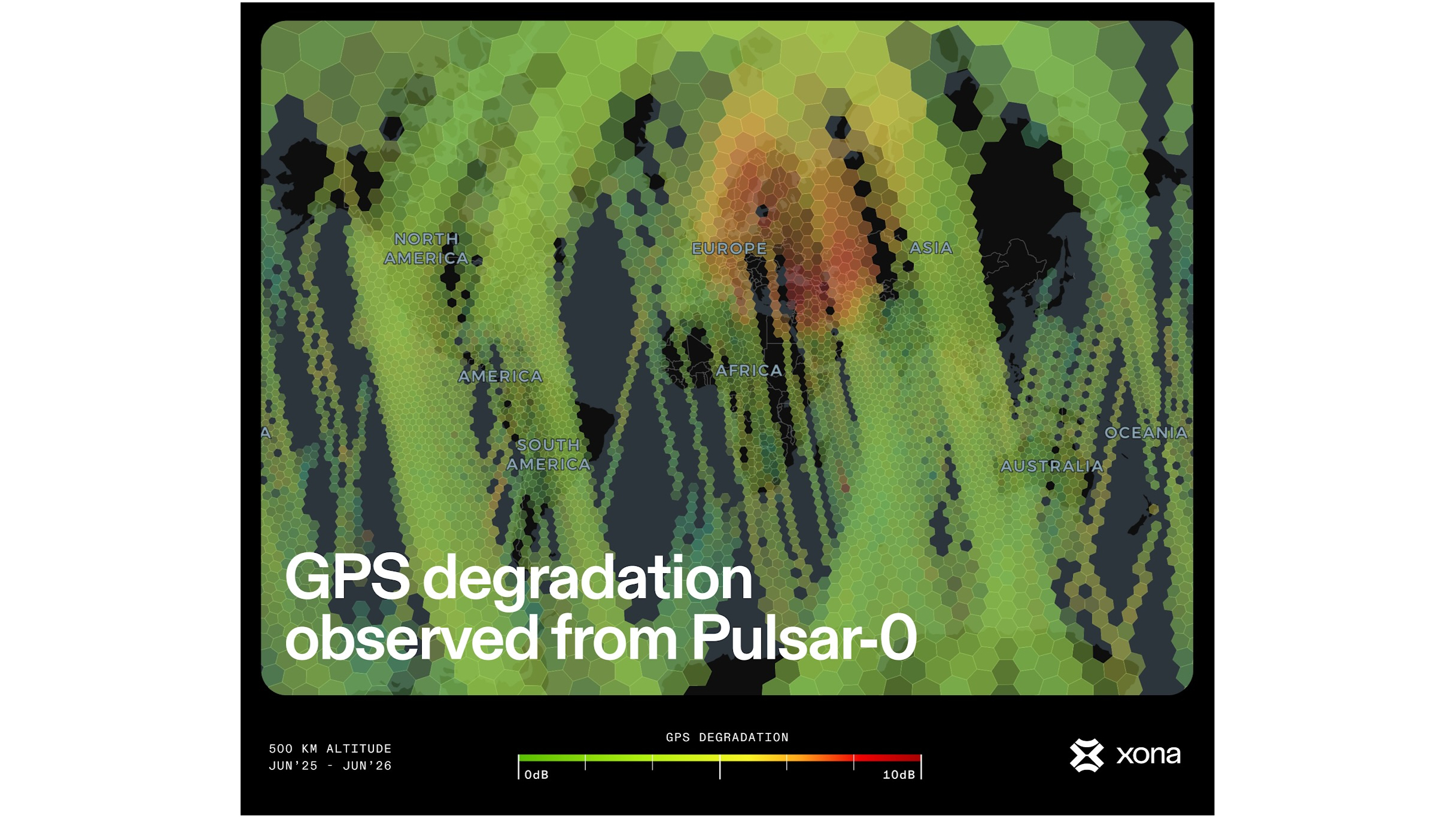
Xona's Pulsar-0 navigation satellite has mapped areas of GNSS jamming on Earth with unprecedented accuracy. (Image credit: Xona)
Xona's satellites will use a similar signal, but one that's 100 times stronger, to offer greater resiliency against such deliberate interference. But the Pulsar-0 spacecraft also carries a GPS receiver to make sure the two systems will be able to work together. When the Xona team first turned on that receiver a few months after Pulsar-0's launch last year, they were shocked by the scale of signal degradation the receiver was reporting above Europe and parts of the Middle East.
"When we fly over North America, for example, we see a beautiful signal all the time," Kaz Gunning, Xona's co-founder, told Space.com. "But as soon as we started doing any operations above Europe, we noticed that there was really something going on there. We thought we were going to see some jamming, but it's quite a bit more than we expected."
In the hardest-hit areas, the strength of the GPS signals at the satellite's altitude dropped from the regular 40 decibels to as little as 10 decibels.
Gunning says that, due to the altitude of the Pulsar-0 satellite, the map may not truthfully reflect where jamming is worst for users on the ground. The data, however, revealed that satellites in heavily used LEO suffer from some degree of GPS signal disruption all the way from France in the west to the borders of Pakistan in the east.
The measurements mean that satellites in LEO are not out of the reach of ground-based jammers, and that the PNT signals those satellites need to time-sync their operations and determine their position in space can't always be relied upon.
"You lose the GPS capability as soon as you pass over these regions," said Gunning. "That may be a problem for imaging satellites that are trying to position themselves to take images of a certain region. You can't do altitude determination, you can't do the positioning without the GPS signal. You can't even accurately point at your telecommand antenna on the ground. That's generally going to disrupt satellite operations."
Satellite constellations such as SpaceX Starlink also rely on GPS to avoid collisions with other spacecraft.
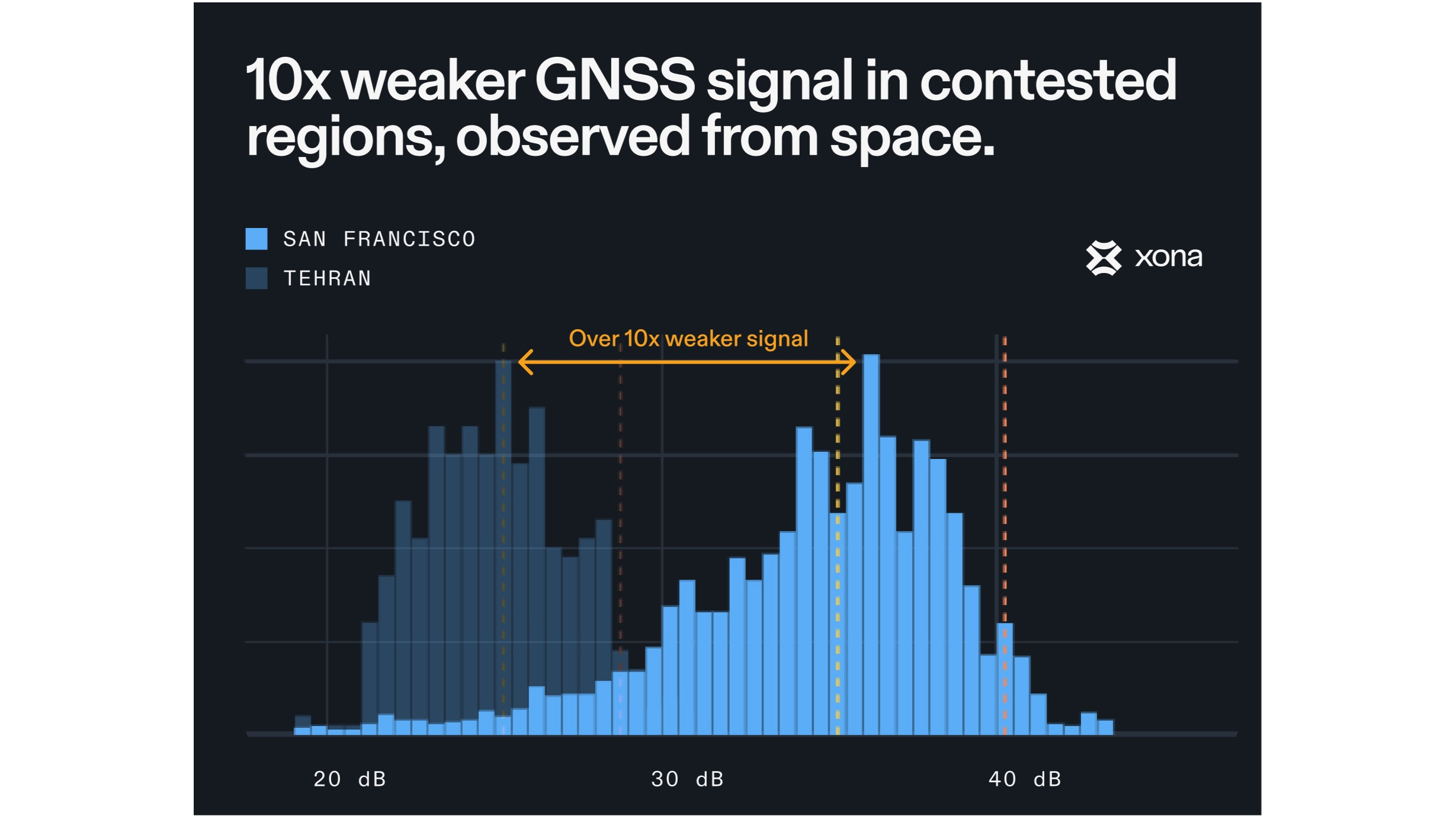
Pulsar-0 has found that GNSS signals are tampered with more extensively over regions in conflict. (Image credit: Xona)
It's not just deliberate jamming and spoofing that can wreak havoc with the precious PNT signal. Severe solar storms, too, can cause serious disruptions. The Gannon superstorm in May 2024, for example, distorted the GNSS signal so much that precision farming machinery in parts of the U.S. couldn't operate for days. Technologists are therefore racing to find backup solutions to transmit the PNT signal to everyone who needs it whenever GNSS is down.
Xona hopes that the Pulsar constellation, once up and running, will make the lives of those dependent on GNSS much easier.
Gunning says that, with the superior strength of the PNT signal transmitted by the company's planned LEO constellation, existing jammers would only be able to affect about 5% of the area they can currently disrupt.
"The effect of the jamming is going to be reduced to a smaller radius," Gunning said. "The degradation area will go down, and the full lock-out radius will also go down."
Xona plans to launch a batch of six satellites in October and begin ramping up production shortly thereafter. The company raised $170 million in a "Series C" funding round this March and hopes to begin delivering basic service in early 2027.
"We expect early customers in timekeeping to begin utilizing Pulsar at the end of this year with intermittent coverage," Max Eunice, Xona's head of communications, told Space.com. "Pulsar's capability will increase with every subsequent launch, unlocking new advantages for new customer segments as our constellation fills out."
这条对你有帮助吗?