Moebius: 0.2B image inpainting model with 10B-level performance
摘要
文章介绍 Moebius,一款专门针对图像修补任务设计的 0.22B(226M)参数模型。作者声称其参数规模不到 FLUX.1-Fill-Dev(11.9B)的 2%,单卡推理延迟约 26ms / step,总体运行时间相比 10B 级模型可提升超过 15 倍,同时在 6 个自然场景和人像场景基准上达到与 FLUX.1-Fill-Dev、SD3.5 Large-Inpainting 相当,部分场景更优的修补质量。文章重点介绍了三项技术:LλMI Block 架构(通过固定大小线性矩阵重构 attention,降低计算开销)、自适应多粒度蒸馏策略(在 latent space 中从 PixelHacker 教师模型迁移能力,并对特征和扩散轨迹进行多层监督)、以及针对轻量架构与蒸馏之间约束关系的协同优化。整体定位是面向图像修补和 AI 去物体(object removal)的轻量化专用模型,而非通用大模型路线。
荐读理由
0.22B Moebius 用 LλMI Block 把注意力压成固定线性矩阵,15×更快 26ms/step,蒸馏 PixelHacker 后在 6 基准上打平甚至超越 FLUX.1-Fill-Dev 10B 模型,适合复杂纹理与人脸 inpainting。
原文
📉 Extreme Parametric Efficiency (< 2%): Moebius operates with a mere 0.22B (226M) parameters, which represents less than 2% of the size of the colossal industrial giant FLUX.1-Fill-Dev (11.9B). It shatters the heavy-compute narrative, making high-quality inpainting accessible on consumer-grade and edge devices.
⚡ 15× Inference Speedup (26ms/step): Achieves a blistering inference latency of only 26.01 ms per step on a single GPU. Combined with optimized sampling steps, Moebius delivers an overall >15× total runtime acceleration compared to 10B-level models.
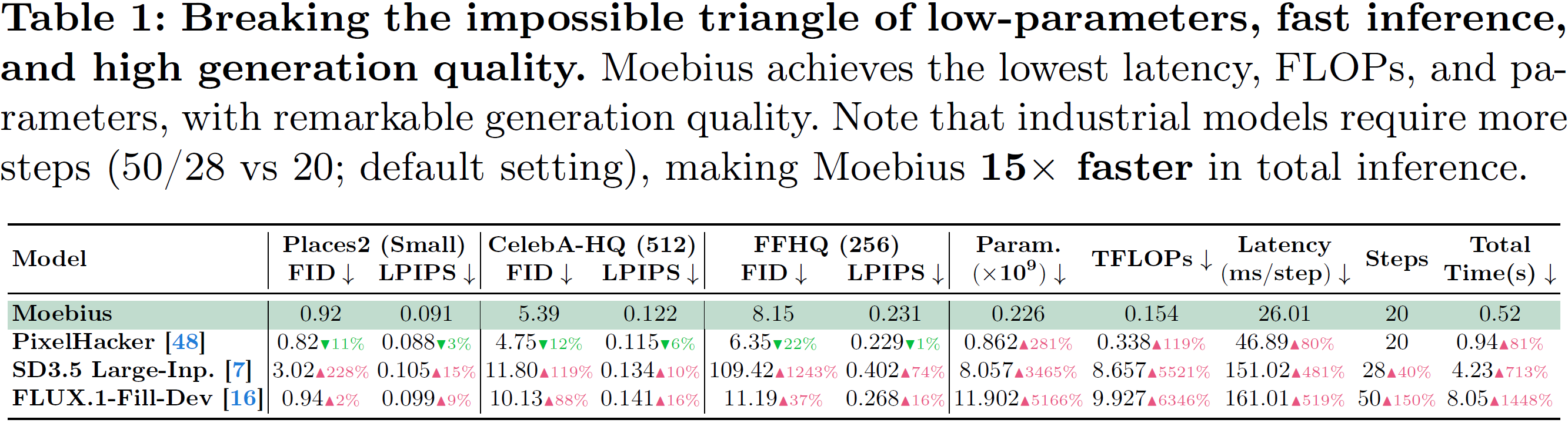
🏆 10B-Level Inpainting Quality (on-par-with/surpass FLUX.1-Fill-Dev across 6 benchmarks): Size contraction does not mean representation degradation. Through the synergistic optimization of architecture and distillation, Moebius performs on par with, and in certain scenarios (such as complex textures and facial plausibility), surpasses 10B-level state-of-the-art (SOTA) generalist models (FLUX.1-Fill-Dev, SD3.5 Large-Inpainting) across 6 comprehensive benchmarks spanning both natural scenes (Places2) and portrait scenes (CelebA-HQ, FFHQ).
💡 Synergistic Core Innovations:
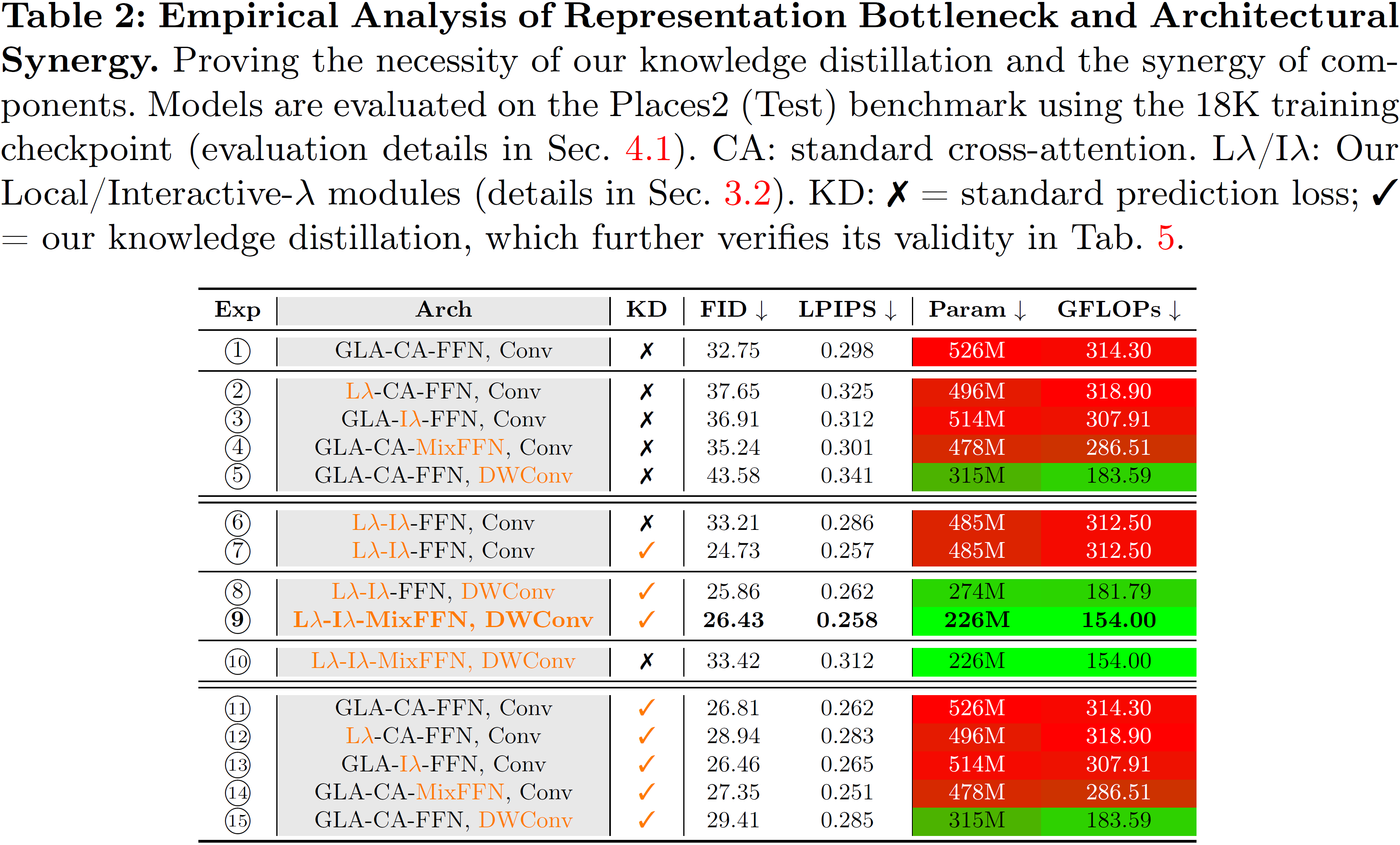
Architecture Design (LλMI Block): Reformulates both self- and cross-attention by condensing spatial context and global semantic priors into fixed-size linear matrices, bypassing quadratic computational overhead.
Adaptive Multi-Granularity Distillation Strategy: Transfers the representational capacity from our PixelHacker (teacher) strictly within the latent space (avoiding expensive pixel-space decoding). It bridges the giant capacity gap by aligning multi-granularity supervision—ranging from microscopic intermediate features to macroscopic diffusion trajectories—while dynamically balancing training via a gradient norm adaptive loss weighting mechanism.
Optimal Synergistic Balancing: Systematically explores the mutual constraint and upper bound between compact structure and distillation. By mapping this architecture-distillation synergy frontier, we ensure our 0.22B Moebius (student) absorbs the maximum semantic reasoning of PixelHacker (teacher) without triggering representation saturation.
- 🚀 Task-Specific Specialist over Bloated Generalists: Rather than blindly scaling up, Moebius answers a fundamental question: Can a model be smarter, lighter, and faster when the task is explicitly defined? It serves as a highly optimized specialist that liberates real-world image inpainting and AI object removal from parameter bloat.
这条对你有帮助吗?